Detroit’s downward spiral has been legendary. Once the fourth largest city in the nation, and home to its largest industry, Detroit’s population has been cut in half, from 1.5 million in 1970, to less than 700,000 in 2012. Median household income is $27,862 compared to the state median of $48,669. The poverty level is 36.2 percent compared to a statewide level of 15.7. The murder rate is 11 times that of New York City, and the unemployment rate is above 18 percent, more than double the national average. Detroit Public Schools (DPS) have been under emergency management since 2008. In late February, the state review board revealed that the city faces a short-term cash $327 million budget deficit and an estimated $14 billion in long-term debt, primarily driven by unfunded pension and retirement health care obligations.
As a result, the city can’t provide basic services. The Detroit Fire Department is so short of critical resources, rotating ”brownouts” of fire companies are required. Forty percent of the city’s street lights are broken. For the past two years, the Bing administration has slowly adopted a city “triage” system, best described by the Detroit Free Press. “Infrastructure improvements, demolition activity, outdoor maintenance and development incentives will henceforth be concentrated in a relatively small number of neighborhoods that boast the high numbers of owner-occupied homes and little evidence of residential and commercial blight,” it reports.
To accord with this plan, the city’s 139 square miles have been broken down into four categories by Detroit’s Planning and Development Department: “steady,” as in little blight and a high number of owner-occupied homes; ”transitional,” as in a neighborhood on its way up or down; “varied” as in some streets are stable and others are not; and ”distressed” as in large amounts of blight, and few amenities, such as grocery stores.
Detroit residents have responded in kind. A staggering 47 percent of the owners of Detroit’s 305,000 properties didn’t pay their property taxes in 2012. Homeowner Fred Phillips illuminated the frustration many of those residents feel. ”Why pay taxes?” he asks. “Why should I send them taxes when they aren’t supplying services? It is sickening….Every time I see the tax bill come, I think about the times we called and nobody came.”
Yet it’s even worse than that. Detroit has some of the highest big city property taxes in the nation, and property assessments remain overly inflated, amounting to as much as ten times the market price of the property, according to recent research compiled by two Michigan professors.
This has led to another phenomenon. Property owners are allowing themselves to be foreclosed upon, and then re-buying the same property at a reduced price, legally eliminating their outstanding debt in the process. Six hundred properties were repurchased in this manner in 2012, triple the number that occurred in 2010.
In short, Detroit is a city on the brink of ruination.
~ Arnold Ahlert

Monday, March 4, 2013
Quote of the Day: Detroit


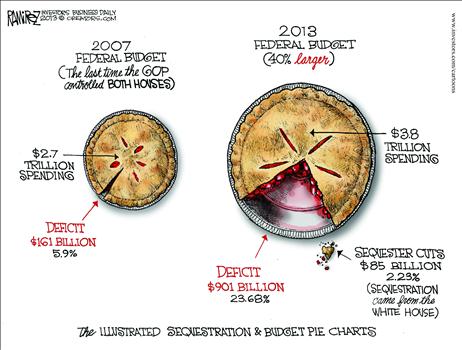
The Sequester Apocalypse is Upon Us

Mother of all horrors---- the sequester apocalypse is upon us and all sorts of havoc is hitting me personally. I woke up this morning and my car won't start because all the gas had mysteriously disappeared from the gas tank. My cupboards were bare even though I went to the grocery store on Sunday, and the dog had no food and had to scavenge the neighborhood for food. Even my bank accounts were drained all because the politicians didn't get the money to spend that wanted even though they stamped their feet and demanded. The sequester apocalypse has arrived and all sorts of bad things are starting to happen around the country....... oh, wait a minute, my mistake.... thecar does start, my cupboards are fully stocked, the cable TV still works, the dog is fat and happy...... what am I missing?
Politicians, being politicians, and deriving most of the power from other people's money they've voted to confiscate to fuel their spending addiction, will only cut in ways most painful for their constituents (even though there is at least 10% waste, fraud and abuse at most agencies) so that there will be an outcry from the people to restore the funding. This trick has been played for years at the local, state and federal levels when spending cuts (or the growth in spending is cut in this case) are implemented. Don't fall for it. The government is in dire need of spending cuts and some restraints on its abuse of taxpayers. This is a good first step.
Bring on the locusts

Sunday, March 3, 2013
Quote of the Day: C.S. Lewis
Of all tyrannies, a tyranny sincerely exercised for the good of its victims may be the most oppressive. It would be better to live under robber barons than under omnipotent moral busybodies. The robber baron's cruelty may sometimes sleep, his cupidity may at some point be satiated; but those who torment us for our own good will torment us without end for they do so with the approval of their own conscience.
~ C.S. Lewis
Wednesday, February 27, 2013
Monday, February 25, 2013
Sunday, February 24, 2013
How to Automatically Include Stock Dividend Information in Google Docs
Microsoft, please pay attention to this article. Excel 2013 is no better than any previous versions of Excel at automatically importing stock information which is why Google Docs has become my spreadsheet of choice.
Google provides a great stock market oriented function called GoogleFinance that is very easy to use. For example, if an investor wants to retrieve a near real-time stock price into a Google Docs spreadsheet all they need to is include the function--- =GoogleFinance("GOOG", "price") or =GoogleFinance(B2, "price"), where cell B2 contains the ticker symbol.
The following types of real-time market data are currently available:
Google provides a great stock market oriented function called GoogleFinance that is very easy to use. For example, if an investor wants to retrieve a near real-time stock price into a Google Docs spreadsheet all they need to is include the function--- =GoogleFinance("GOOG", "price") or =GoogleFinance(B2, "price"), where cell B2 contains the ticker symbol.
The following types of real-time market data are currently available:
- price: market price of the stock - delayed by up to 20 minutes.
- priceopen: the opening price of the stock for the current day.
- high: the highest price the stock traded for the current day.
- low: the lowest price the stock traded for the current day.
- volume: number of shares traded of this stock for the current day.
- marketcap: the market cap of the stock.
- tradetime: the last time the stock traded.
- datadelay: the delay in the data presented for this stock using the googleFinance() function.
- volumeavg: the average volume for this stock.
- pe: the Price-to-Earnings ratio for this stock.
- eps: the earnings-per-share for this stock.
- high52: the 52-week high for this stock.
- low52: the 52-week low for this stock.
- change: the change in the price of this stock since yesterday's market close.
- beta: the beta value of this stock.
- changepct: the percentage change in the price of this stock since yesterday's close.
- closeyest: yesterday's closing price of this stock.
- shares: the number of shares outstanding of this stock.
- currency: the currency in which this stock is traded.
Notice that information on dividends is lacking from the list of options. This is not a good thing if you are a dividend oriented investor. Luckily, there is a relatively easy way to correct his oversight using either the google or yahoo finance web sites.
Current Dividend Yield
To obtain the current dividend yield of a stock, simply copy one of the two formulas into the cell in google docs where you want dividend yield to appear.
=REGEXreplace(REGEXextract(REGEXreplace(index
(importhtml("http://finance.yahoo.com/q?s=NLY&ql=1", "table", 3), 8,
2); "[()]"; "") ; "..[^a-zA-Z][.0-9].%$"); "[%]"; "") -- obtains dividend yield for NLY from yahoo finance
=REGEXextract(REGEXreplace(index
(importhtml("https://www.google.com/finance?q=NYSE%3ABIP", "table", 2),
1, 2); "[()]"; "") ; "/([^/]*)") -- obtains dividend yield for BIP from google finance
Current Dividend Amount
To obtain the current dividend amount of a stock, copy one of the two formulas into the cell in google docs where you want dividend amount to appear. These sites are inconsistent in how they display dividends-- sometimes they show the quarterly dividend amount and other times the yearly amount. So you might have to make the appropriate adjustments.
=REGEXextract(REGEXreplace(index
(importhtml("http://finance.yahoo.com/q?s=NLY&ql=1", "table", 3), 8,
2); "[()]"; "") ; "([^/]*) ") -- obtains dividend amount for NLY from yahoo finance
=REGEXextract(REGEXreplace(index
(importhtml("https://www.google.com/finance?q=NYSE%3ABIP", "table", 2),
1, 2); "[()]"; "") ; "([^/]*)/") -- obtains dividend amount for BIP from google finance
A Word of Caution
If either site changes their layout, these formulas will have to be adjusted to compensate.
Subscribe to:
Posts (Atom)